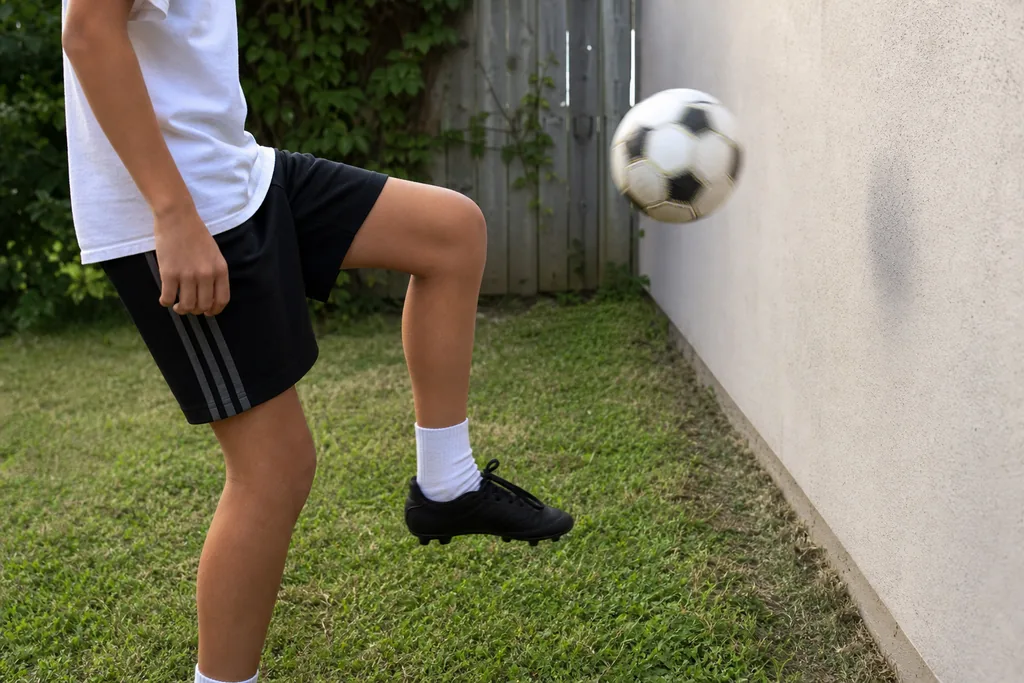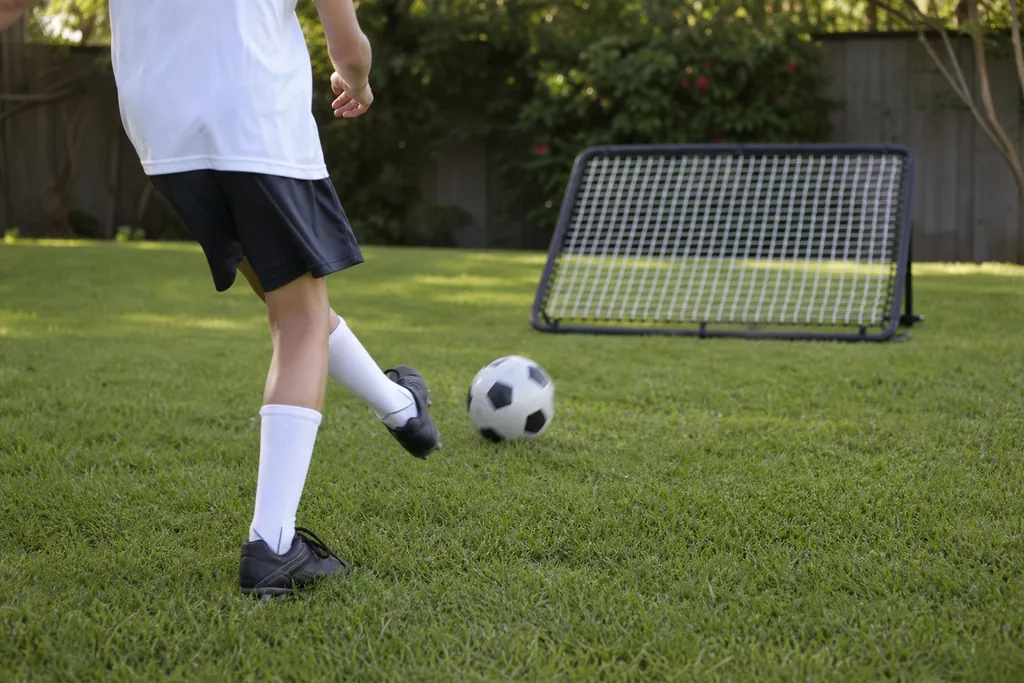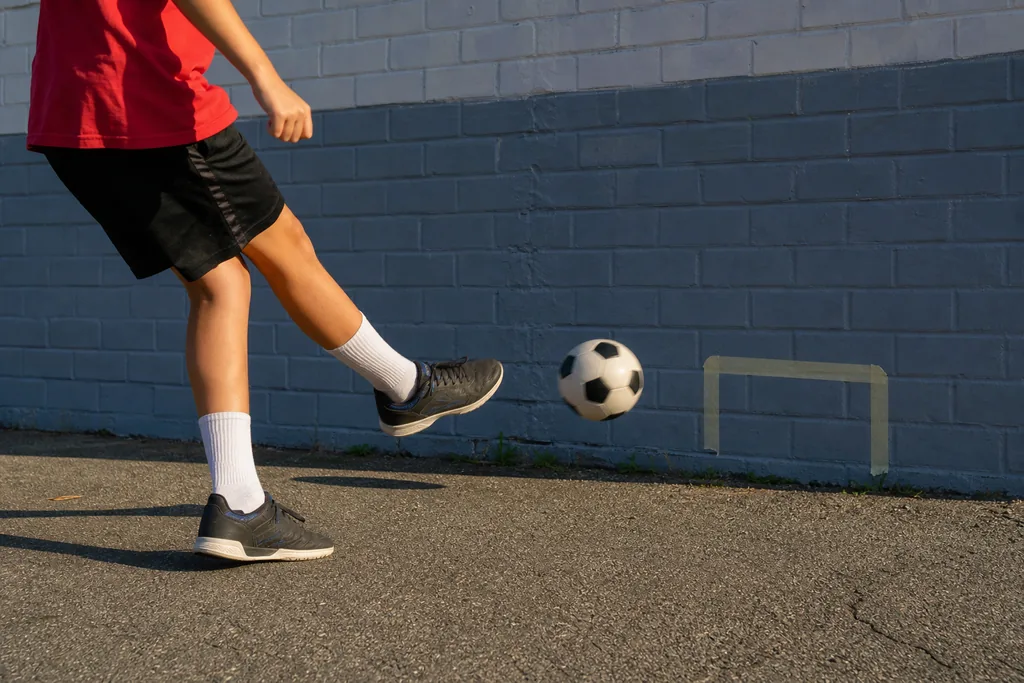
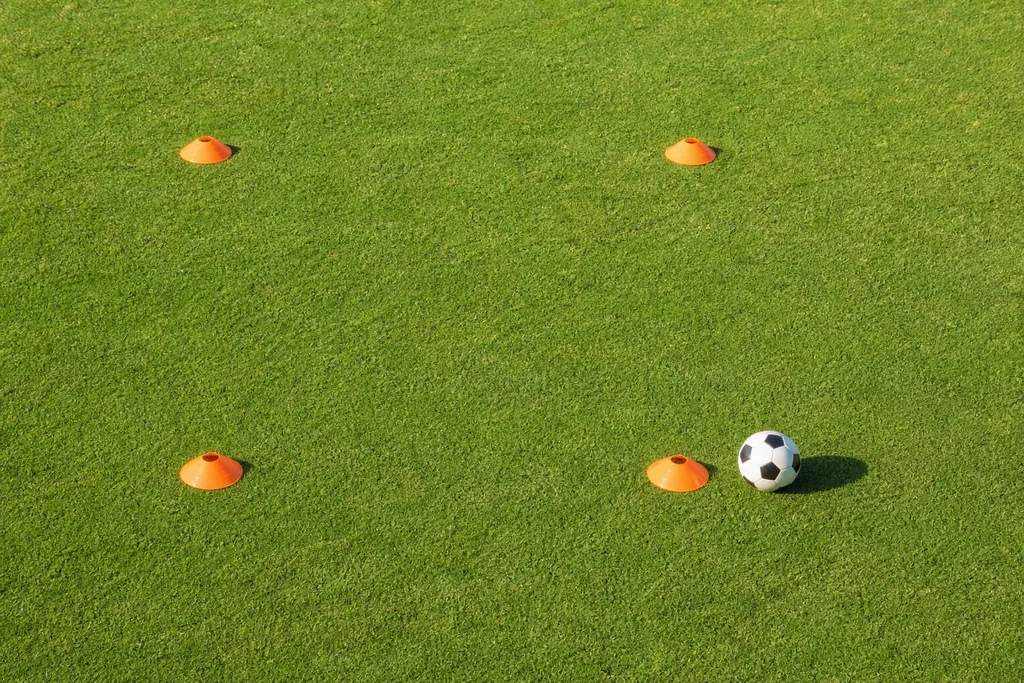
Box Dribbling is a Beginner drill that improves turning and control with different parts of the foot. You set 4 cones in a square about 5 yards on each side, dribble around the outside and turn at every corner. One way you turn with the inside of your foot; the other way you use the outside. Four laps each way. It’s a simple shape that teaches one of the most useful skills in the game: turning with the ball.
Why corners matter
Dribbling in a straight line is the easy part. Games are full of moments where you have to change direction with the ball, without losing it and without slowing to a stop. Every corner of the box is one of those moments. Four corners a lap, eight laps a session: that’s a lot of turns.
The box also makes you use both directions equally. Many players have a favorite way to turn without realizing it. Going round the box both ways shows you which side needs more work.
Setting up
Use four disc cones on flat grass or a driveway. Pace out roughly 5 yards between them to make a square. If you don’t have cones, shoes or water bottles work for the first session. Our guide to disc cones or tall cones explains why low cones suit this drill.
What to focus on
- Slow down into the corner. Take a smaller touch just before you turn, so the ball is close when you need it.
- Turn with the right surface. Inside of the foot one direction, outside of the foot the other, as the drill asks.
- Push out of the turn. After the corner, a slightly bigger touch gets you moving again.
- Stay outside the cones. Cutting inside the box makes the turns easier and the drill less useful.
Common mistakes
- Arriving at the corner with the ball too far ahead, so the turn becomes a chase.
- Turning with the sole every time because it feels safe.
- Going faster than you can control. Speed comes after clean turns, not before.
- Doing all the laps in one direction and skipping the outside-foot side.
Make it easier
Walk the first lap each way, touching the ball at every step. Then jog. If the outside-foot turns are hard, make them wider and slower until they feel natural.
Make it harder
The drill’s own step is the best one: make the box smaller. A 3- or 4-yard box means sharper turns and less time between them. You can also time four laps, switch to your weaker foot only, or call out a direction change halfway round.
A sample session
- Warm-up: 2 slow laps each way, walking pace.
- Main set: the drill’s 4 laps each way, inside turns one way and outside turns the other.
- Challenge: shrink the box by a yard and do 2 more laps each way.
- Finish: one timed lap each way.
Keep the timed laps honest. A lap with a lost ball doesn’t count, so the clock rewards control as well as speed.
Related drills
For more direction changes, try Figure 8 Dribbling and V Dribbling. Practice Notes: Cone Dribbling covers a straight-line drill that builds the close touch these turns need. Find more in our dribbling drills.