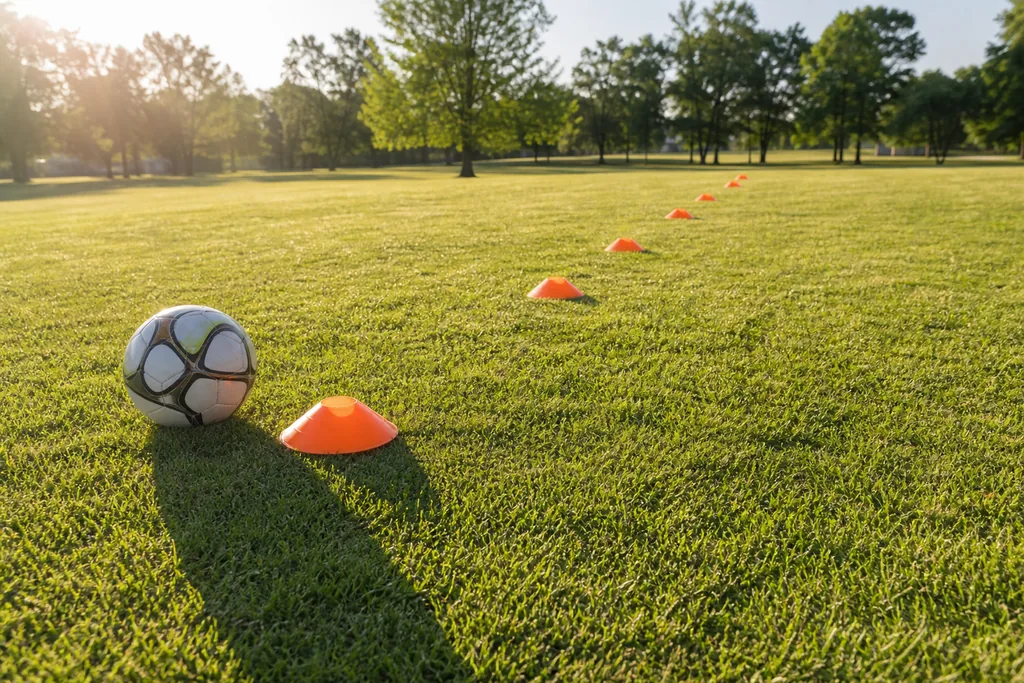
Slalom Dribbling is an Advanced dribbling drill, and all it asks for is a set of cones and a ball. The goal is tight, quick ball control at speed. You line up 8 cones about 1 yard apart and weave through every one with small, fast touches, then jog back and go again for 8 runs. These slalom dribbling tips are about getting through the line cleanly first, and fast second.
Why the tight spacing matters
With only a yard between cones, a loose touch has nowhere to hide. Each cone is a small decision: go around it, then come back across. In a match, that same rhythm lets you carry the ball through a crowded patch of the field where defenders leave you very little room.
This drill is rated Advanced for a reason. The gaps are small and the speed is high. If regular cone dribbling still feels shaky, spend some time there before you come back to the slalom.
Laying out the line
Find a flat strip of grass or pavement with space for 8 cones in a row and a few extra steps at each end. Measure the first gap with a yardstick or tape so the whole line stays even. Low disc cones are kinder if you clip them, and there’s a short guide to disc cones or tall cones if you’re picking some up. Set the ball beside the first cone and stand behind it, ready to go.
What to think about on each run
- Outside around, inside back. The drill gives you the pattern. The outside of your foot carries the ball around a cone, and the inside brings it back across your body.
- Bend your knees. A lower stance lets you shift your weight quickly from one side to the other.
- Ball within a step. Once it drifts farther than that, the next cone shows up before you’re ready.
- Lots of little touches. Small taps give you more chances to fix your line than a few big pushes.
Where runs usually go wrong
- Running in a straight line and dragging the ball side to side, so your feet and the ball never line up.
- Using one foot for the whole line because it feels safer.
- Staring at the cones and losing track of the ball, or staring at the ball and clipping every cone.
- Going flat out on the very first run. The drill’s own rule helps here: if you knock a cone, slow down a little on the next run.
Making it easier
Spread the cones a bit wider while you learn the pattern, or use 5 or 6 instead of 8. Walk the line once without a ball so your feet learn the path. Then dribble it at a gentle jog. When you can finish a run without touching a cone, slide them back to 1 yard apart.
Making it harder
- Time each run and try to beat your best without knocking a single cone.
- Do a full run with your weaker foot only.
- Burst for a few yards past the last cone, as if you’ve just beaten a defender.
- Lift your eyes for a quick look between cones, the way you’d check for a teammate.
A sample session
- Walk the line once with no ball, then do 2 slow warm-up runs.
- Runs 1 to 4: steady pace, saying “outside, inside” in your head at every cone.
- Runs 5 to 8: pick up speed, easing off on the next run any time a cone goes over.
- Use the jog back to the start as your rest between runs.
- Write down how many of your 8 runs were clean.
Related drills and notes
For a wider weave, try Cone Weave Dribbling or the angled path in Zigzag Dribbling. The cone dribbling practice notes cover the basics this drill builds on. When you want to test yourself, the Speed Dribbling Challenge is a good next step, and all our dribbling drills are on one page.