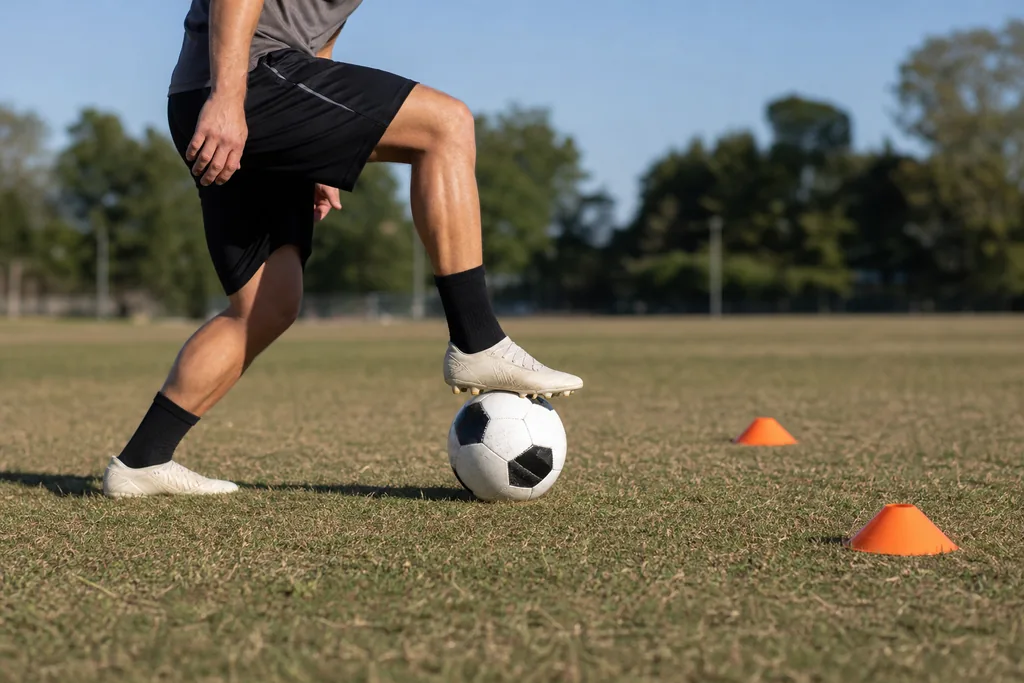
Stop and Go Dribbling is an Intermediate dribbling drill that uses two cones to mark a lane. The goal is better control when stopping, starting and changing direction quickly. You dribble forward at a jog, stop the ball dead with the sole of your foot, change direction with a pull-back or a turn, then go again at speed. Stopping and starting with the ball is a skill defenders hate to face, because they never know when you’ll move.
Why the sudden stop works
A defender running alongside you is matching your speed. When you stop sharply, they often keep going for a step or two. That gap is your chance to turn away or push past. This drill trains the stop, the change and the restart as one smooth piece, so it feels natural in a game.
It also builds patience. Many players only know one speed, flat out. Learning to slow down, stop and then choose your moment makes you much harder to read, even if you aren’t the fastest player on the field.
Marking the lane
Set two cones about 15 yards apart on a flat, clear space, such as a lawn, a park field or a long driveway. Make sure there’s nothing to trip over near either end, since you’ll be turning there often. Mini disc cones are handy for this. A set like the Kwik Goal mini disc cone kit is one option if you don’t have any yet.
Focus points
- Sole on top for the stop. Put your foot on the ball firmly enough that it stops dead, not halfway.
- Lower your body as you stop. Bending your knees keeps you balanced when your weight shifts.
- Mix your changes. Use a pull-back one time and a turn the next, as the drill suggests.
- Explode out. The restart should be clearly faster than the jog that came before it.
Watch out for
- Slowing down gradually before the stop, which gives the move away.
- Stopping the ball but leaving it a yard ahead of you.
- Doing the same turn every time.
- Restarting at the same jog instead of a real burst.
An easier start
Walk the lane at first, stopping the ball every few steps. Practice only the sole stop until it’s reliable, then add the pull-back. Bring in turns once you can stop and pull back without the ball rolling away.
Turning up the difficulty
- Jog a little faster before each stop.
- Have someone call “stop” at random so you can’t plan it.
- Use your weaker foot for every stop on one length.
- Count your stops and aim for 5 on each length without losing the ball.
A sample session
- Warm up with an easy length, dribbling with small touches.
- Lengths 1 and 2: stop and go 4 or 5 times each, using a pull-back.
- Lengths 3 and 4: use a turn after each stop.
- Lengths 5 and 6: mix it up, choosing a different stop or turn each time.
- Rest briefly between lengths so every restart stays sharp.
Related drills and notes
V-Cut Dribbling trains a different kind of direction change, and its practice notes are a good companion read. Box Dribbling adds sharp turns at corners. For a structured workout, try the Change of Direction Challenge, and explore all our dribbling drills.