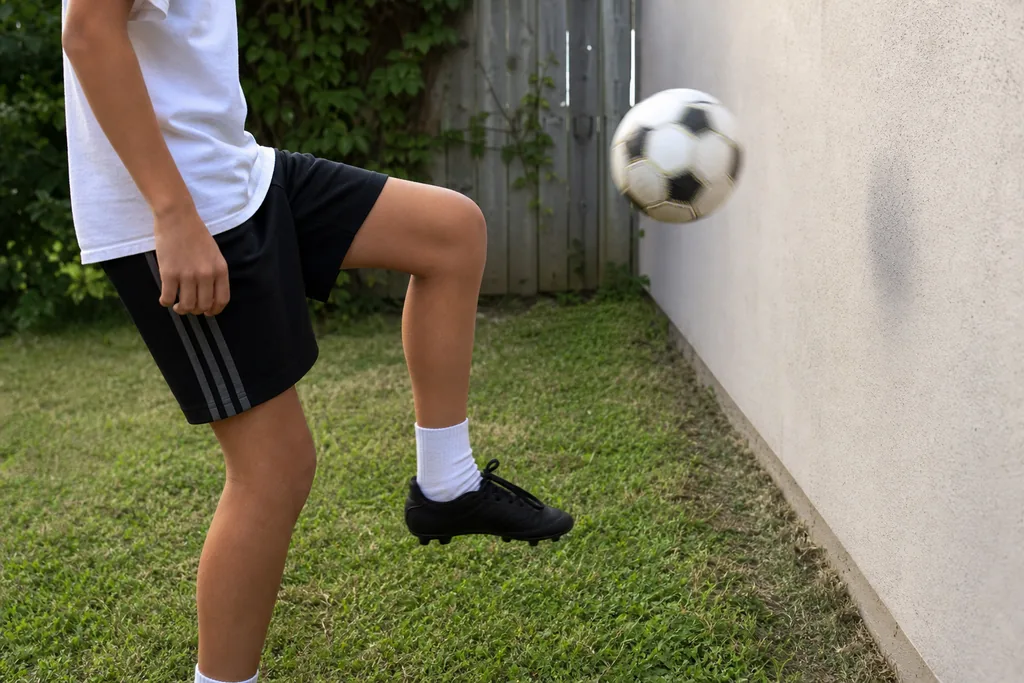
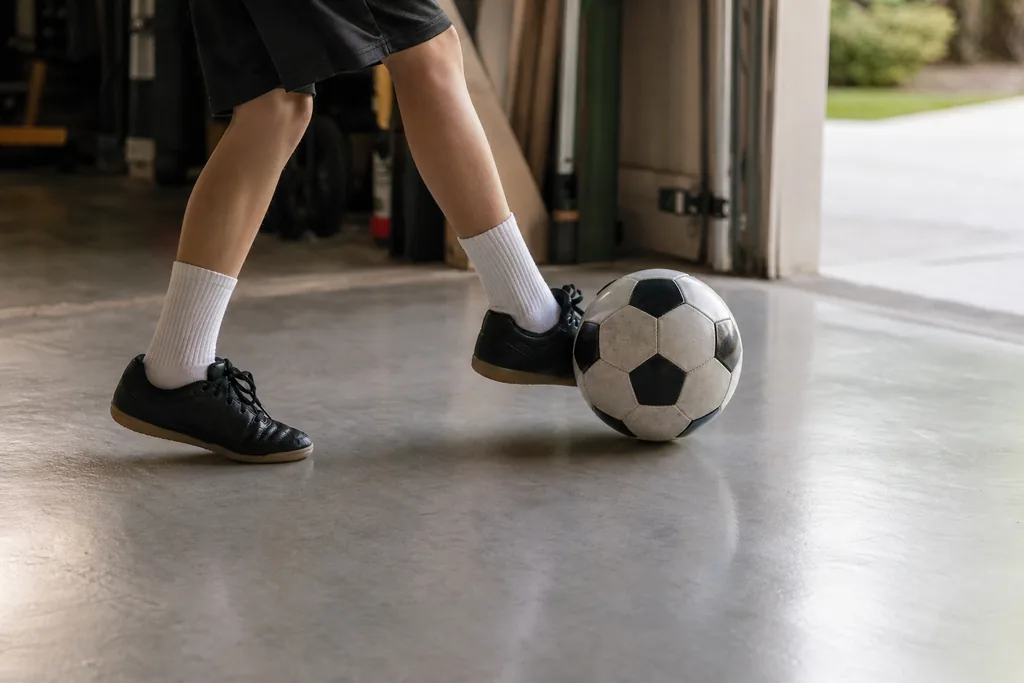
Inside-Outside Dribbling is a Beginner footwork drill that needs nothing but a ball. Its goal is to improve ball control and quick footwork with the inside and outside of each foot. You tap the ball across your body with the inside of one foot, then back out with the outside of the same foot, keeping the touches small and quick. Inside-outside touches are a building block for almost every dribbling move.
Why such a small drill helps so much
Most cuts and fakes in a game use these two surfaces. A defender steps one way, you shift the ball with the inside, then push away with the outside. Practicing the pattern on the spot trains your foot to switch surfaces without thinking. Because it needs so little space, it’s ideal for a garage, a patio or a short break between homework.
It also trains balance. Every touch happens while you stand on one leg for a split second, so your standing side gets stronger and steadier. Over time, that makes cuts in a real game feel less wobbly.
Finding a spot
Any flat, clear space will do. Start with the ball in front of your right foot. A smooth surface like a garage floor or short grass makes the ball behave, while bumpy lawn can knock it off line. Wear your usual training shoes, or try our guide to training shoes for grass, turf and driveways if you’re not sure what works on your surface.
What to focus on
- Tiny taps. The ball should only travel a short way each touch, about the width of your foot.
- Stay on your toes. Hop lightly on your standing foot between touches.
- Same foot, both surfaces. Inside in, outside out, all on one foot before switching.
- Find a rhythm. A steady tap, tap, tap is better than fast and messy.
- Glance up. Try to look up for a moment every few touches.
Common problems
- Touches getting bigger as you speed up, until the ball rolls away.
- Standing flat-footed, which makes the feet slow.
- Switching feet by accident because one side feels easier.
- Holding your breath and tensing up. Relax your shoulders.
Taking it down a notch
Slow the pattern right down and count each touch out loud. If the outside of the foot feels clumsy, do a few touches with just the outside to get used to it. Shorter rounds of 15 seconds are fine while you learn. You can also place the ball against the side of a step or a low curb so it can’t roll far between touches. Once the rhythm clicks, move back to open ground.
Taking it up a notch
The drill’s next step is to walk forward while doing the pattern, then jog. You can also go longer than 30 seconds on each foot, or try the pattern with your eyes up. For more ball-only footwork, look at Toe Taps and One-Foot Dribbling.
A sample session
- 30 seconds on the right foot, inside and outside taps on the spot.
- 30 seconds on the left foot.
- Short rest, then repeat both feet.
- Finish with one round walking forward on each foot.
- If walking felt easy, try a slow jog on the last round.
Related notes
The notes on toe taps and one-foot dribbling build the same quick feet. See our footwork drills for more, or try the Quick Feet Challenge.